

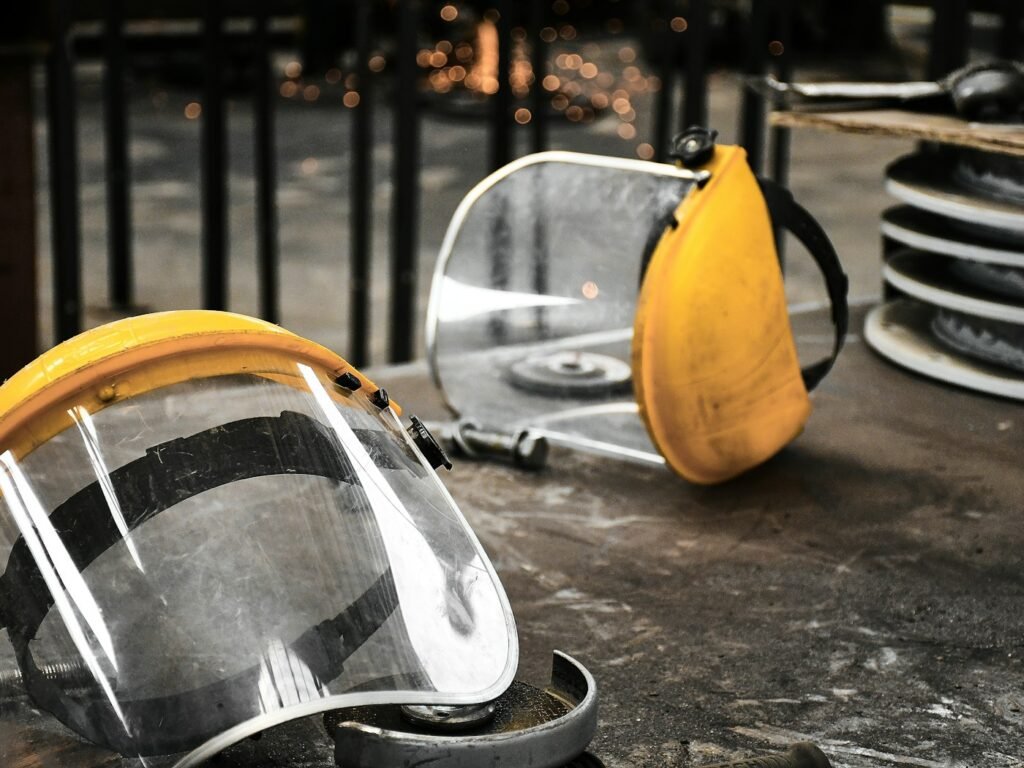
Knowing when to use a face shield at work is straightforward once you accept one rule: a face shield protects the face, and safety spectacles or goggles underneath protect the eyes. A shield is required whenever a hazard can strike the whole face rather than just the eyes, which in practice means grinding, cutting, chemical handling, molten metal, pressure washing and electrical arc work. Al Baraka Diyar supplies polycarbonate, acetate and mesh visors with browguards and helmet adaptors, and this article explains the five task groups where a shield is mandatory and how to read the markings on the visor.
Why shields are worn over, not instead of, eye protection
EN 166 face shields carry the impact marking B (medium energy, 6 mm ball at 120 m/s) or A (high energy, 190 m/s), which is more than a spectacle’s F rating. However, a shield is open at the bottom and sides, and fragments, sparks and liquids can rebound up behind it. OSHAD-SF, Dubai Municipality and Saudi Aramco’s Construction Safety Manual all treat the shield as secondary protection, requiring primary eye protection underneath. On ADNOC sites the hot-work permit normally lists both items. Our safety spectacles are the usual pairing; goggles are required under the shield for chemical work.
The five task groups that require a face shield
| Task group | Typical examples | Visor type | Marking to specify |
|---|---|---|---|
| 1. Abrasive and impact | Angle grinding, disc cutting, chipping, needle gunning, wire brushing | Clear polycarbonate | EN 166 1 B T 9 (or A for high-energy work) |
| 2. Chemical splash | Acid descaling, caustic transfer, battery maintenance, chemical cleaning | Clear acetate or polycarbonate with chin guard | EN 166 3 B, worn over field 3 goggles |
| 3. Molten metal and hot solids | Foundry pouring, oxy-fuel cutting, thermite welding, hot-tapping | Polycarbonate, gold-coated for radiant heat | EN 166 9 B T |
| 4. Electrical arc flash | Switching, racking breakers, live testing above arc-flash threshold | Arc-rated polycarbonate with hood or helmet | EN 166 8 and GS-ET-29 class 1 or 2; ASTM F2178 ATPV |
| 5. Forestry and debris | Brush cutting, chainsaw work, landscaping, pressure washing | Steel or nylon mesh | EN 1731 S or F |
Reading the visor markings
A clear grinding visor typically reads XX 1 B T 3 9 EN 166: manufacturer, optical class 1, medium-energy impact tested at -5 °C and +55 °C, protection against liquid splash (3) and molten metal (9). The browguard or helmet adaptor carries its own marking and must show at least the same impact letter as the visor; a B-rated visor on an S-rated browguard is only rated S overall. Mesh visors to EN 1731 are marked S (increased robustness) or F (low-energy impact) and do not protect against liquids or fine dust. Arc-flash visors are tested to GS-ET-29 and marked with class 1 (4 kA) or class 2 (7 kA); for the full arc-rated ensemble see our arc flash kits.
Browguard or helmet-mounted?
Browguards with a ratchet headband suit workshop tasks where no hard hat is worn. On construction and plant sites the visor should mount to the safety helmet using the manufacturer’s adaptor, keeping head protection in place and allowing the visor to flip up between cuts. Check that the helmet, adaptor and visor are tested as a system; mixing brands can leave gaps at the temple. Chin guards are available for chemical and foundry work and are strongly recommended wherever liquids are handled.
Specifying for GCC heat and glare
- The T marking confirms impact performance at +55 °C and should be mandatory on outdoor work.
- Polycarbonate yellows under intense UV; replace visors on condition rather than waiting for cracks.
- Anti-fog and anti-scratch coatings extend life but cannot be re-applied; buy visors in packs.
- Gold-coated visors reduce radiant heat for furnace and hot-work tasks and improve comfort during summer shifts.
- A tinted shade 3 or 5 visor is suitable for oxy-fuel cutting but not for arc welding, which requires an EN 379 or EN 169 welding filter.
Common mistakes
- Wearing the shield alone during grinding because spectacles fog.
- Flipping a scratched, yellowed visor down and working through it.
- Using a clear visor for arc-flash switching without an arc rating.
- Attaching a visor to a helmet with cable ties or tape rather than the certified adaptor.
- Issuing mesh visors for pressure washing, where the mesh offers no splash protection.
Inspection and replacement
Inspect visors before each use for cracks, crazing, deep scratches and loose pivots. Clean with mild soap and water and a soft cloth; never use acetone or thinners. Replace the visor when optical clarity drops, the surface is pitted by spatter or sand, or after any heavy impact. Browguard headbands and sweatbands are replaceable and should be changed when the ratchet no longer holds.
Related guides: Anti-Fog Safety Glasses for UAE Heat: 6 Features That Matter · Chemical Splash Goggles vs Safety Glasses: Which to Issue? · Auto-Darkening Welding Helmet Shade Guide for GCC Workshops
Key takeaways
- Face shields are secondary protection and are always worn over spectacles or goggles.
- Grinding, chemicals, molten metal, arc flash and debris are the five task groups that require a shield.
- Match the visor marking to the hazard: 3 for liquids, 9 for molten metal, 8 and GS-ET-29 for arc.
- Specify the T marking for UAE and KSA outdoor work.
- Use certified helmet adaptors and replace visors on condition.
Al Baraka Diyar supplies browguards, helmet-mounted visors, chin guards and replacement polycarbonate and mesh screens to contractors in the UAE, with service to Saudi Arabia and India. See our industrial face shields and browguards, browse the full safety products range, or contact our team to specify the right visor for each task.
Face Shield: practical summary
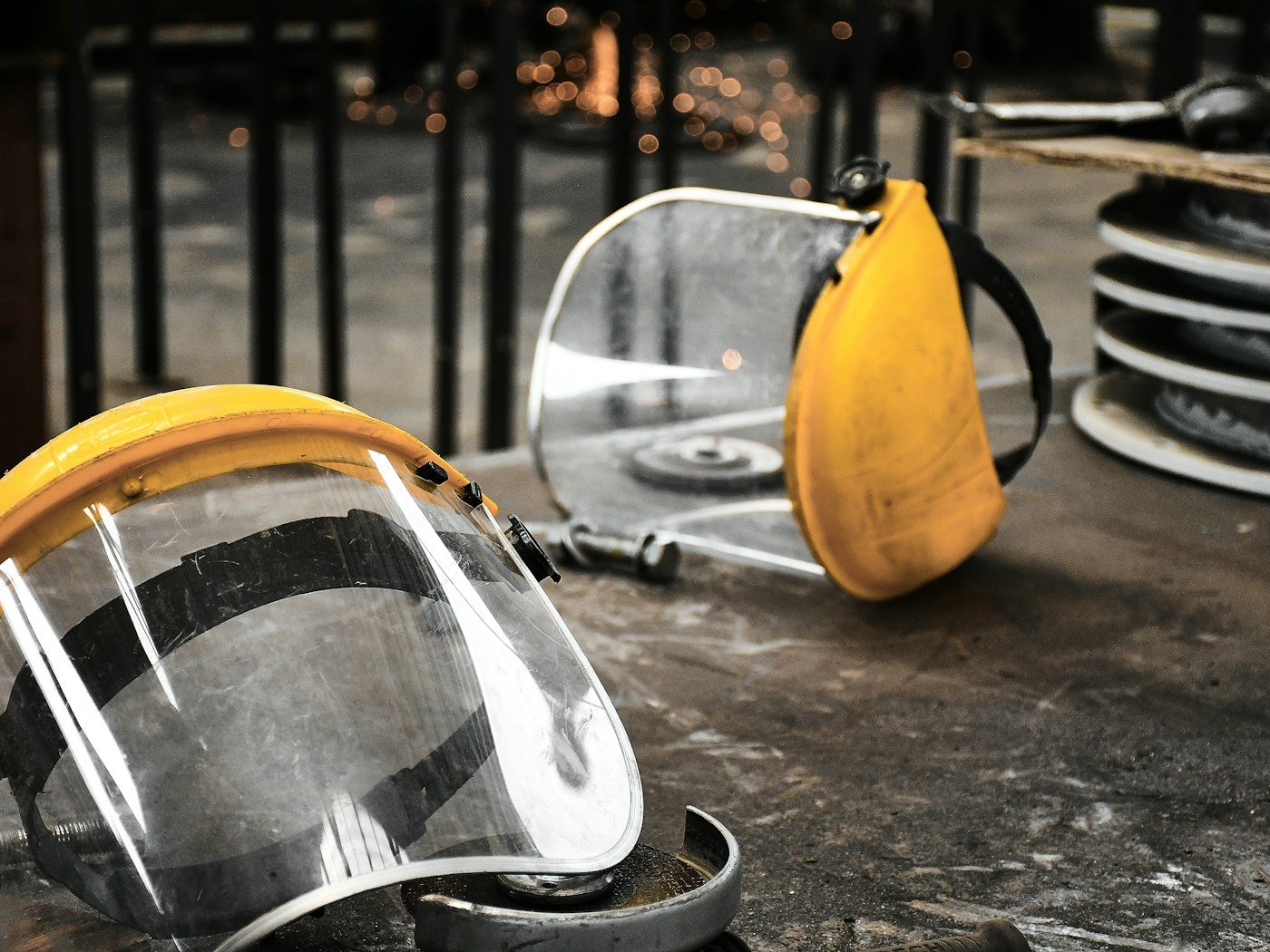
This guide to face shield is written for UAE work sites, and also applies to our service areas in Saudi Arabia and India. If you need help applying face shield on your site, our team can confirm the right option and supply certified stock from the safety products range, or you can request a quotation. For the underlying standards, see the International Organization for Standardization.
Frequently asked questions
Can a face shield be worn without safety glasses?
Not on most UAE or Saudi sites. EN 166 face shields are open at the sides and bottom, so fragments and liquids can rebound behind them. OSHAD, Dubai Municipality and Saudi Aramco guidance all require primary eye protection underneath the shield.
What face shield is needed for angle grinding?
A clear polycarbonate visor marked at least EN 166 1 B T, mounted on a browguard or helmet adaptor with the same impact rating, worn over safety spectacles. The 9 marking adds protection against hot sparks and is worth specifying.
Are mesh face shields suitable for chemical work?
No. Mesh visors to EN 1731 protect against branches and coarse debris only. Chemical splash requires a solid visor marked EN 166 field 3, ideally with a chin guard, worn over indirect-vent goggles marked field 3.