

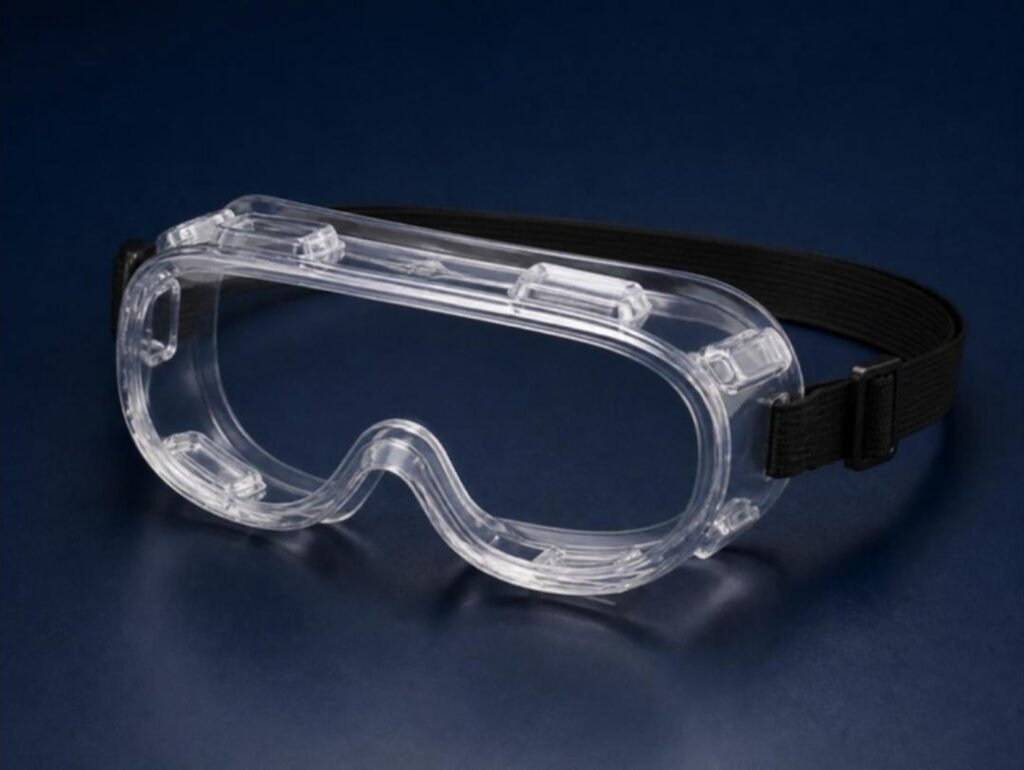
The chemical splash goggles vs safety glasses decision is settled by the hazard: if a liquid, fine dust or gas can reach the eye from any direction, goggles sealed to the face and marked EN 166 field 3, 4 or 5 are required, and spectacles are not acceptable. Safety spectacles protect only against impacts arriving from the front and sides. Al Baraka Diyar supplies both, and this guide explains how the EN 166 fields of use, vent styles and lens options translate into a clear issue policy for UAE, Saudi and Indian workplaces.
Why the distinction matters in GCC industry
Chemical eye injuries are common in water-treatment plants, battery rooms, laboratories, paint shops, concrete batching and the cleaning of heat exchangers with acid descalers. OSHAD-SF Code of Practice on PPE, the Dubai Municipality Code of Construction Safety Practice and ADNOC HSE standards all require eye protection matched to the identified hazard, and Saudi Aramco’s Construction Safety Manual explicitly requires chemical goggles when handling corrosive liquids. Issuing spectacles for a caustic-soda transfer task is a documented non-conformance and, more importantly, a route to permanent eye damage.
EN 166 fields of use explained
The frame marking on EN 166 eye protection includes a field-of-use number. This is what tells you whether the product is a spectacle or a goggle:
| Field of use | Marking | Protects against | Available on |
|---|---|---|---|
| Basic | (none) | Unspecified mechanical hazards, UV, IR | Spectacles, goggles, shields |
| 3 | 3 | Liquid droplets and splashes | Goggles (indirect vent) and face shields |
| 4 | 4 | Large dust particles over 5 µm | Goggles |
| 5 | 5 | Gas and fine dust under 5 µm | Unvented goggles only |
| 8 | 8 | Short-circuit electric arc | Face shields |
| 9 | 9 | Molten metal and hot solids | Goggles and face shields |
Spectacles can never carry fields 3, 4 or 5 because they do not seal. ANSI/ISEA Z87.1 uses the markings D3 (splash and droplet), D4 (dust) and D5 (fine dust) to the same effect.
Vent types: direct, indirect and unvented
- Direct-vent goggles have open holes in the frame. They resist impact and large dust but let liquids in. They are suitable for woodworking and some grinding, not chemicals.
- Indirect-vent goggles use baffled vents that allow air through but block liquid travelling in a straight line. These are the standard chemical splash goggle and carry field 3 and usually 4.
- Unvented (sealed) goggles have no vents and carry field 5 for gases and fine dusts. They fog quickly without a high-quality anti-fog coating and are used for fumigation, ammonia and fine powder handling.
When safety glasses are enough
Spectacles with side shields remain correct for most mechanical tasks: general construction, assembly, electrical installation, inspection and driving plant. They are lighter, cooler and fog less, which is why they are the default on GCC sites. See our guide to safety spectacles for lens markings. The moment the risk assessment adds a liquid, a fine powder or a gas, however, the spectacle is replaced, not supplemented.
When goggles are mandatory
- Transferring, diluting or sampling acids, alkalis, solvents and oxidisers.
- Cleaning with pressurised water or chemicals, including heat-exchanger descaling.
- Battery charging and electrolyte handling in forklift and UPS rooms.
- Cement, lime and dry-mix handling where fine alkaline dust is airborne.
- Spray painting, blasting and fumigation.
- Laboratory work with open vessels.
Where a splash could hit the face as well as the eyes, goggles are worn under a face shield; the shield alone is not a substitute because liquid can run up underneath it.
Choosing goggles for the Gulf climate
Goggles trap more heat and humidity than spectacles, so specification matters. Look for a wide, soft PVC or TPR body that seals without pressure, an elastic headband that fits over a helmet, an indirect-vent system with large vent area, and a polycarbonate lens marked 1 B T K N (optical class 1, medium-energy impact at extreme temperatures, anti-scratch, anti-fog). Lenses should be replaceable so that a scratched lens does not mean a new goggle. Over-the-spectacle (OTG) designs are essential for workers who wear prescription glasses.
Common mistakes
- Issuing direct-vent goggles for chemical work because they fog less.
- Allowing goggles to be worn loose on the forehead between tasks, which stretches the strap and breaks the seal.
- Cleaning lenses with solvents, which crazes polycarbonate.
- Not pairing goggles with an emergency eyewash station within ten seconds of the hazard.
- Ignoring the chemical compatibility of the goggle body with the substance handled.
Maintenance and replacement
Rinse goggles after chemical exposure, wash the body with mild soap, and store in a pouch. Replace the headband when it loses tension and the lens when scratched or crazed. A chemical goggle used daily on a GCC site typically lasts three to six months.
The chemical splash goggles vs safety glasses decision depends on liquid hazards. Choose the right chemical splash goggles vs safety glasses option per task. Train on chemical splash goggles vs safety glasses differences.
Related guides: Anti-Fog Safety Glasses for UAE Heat: 6 Features That Matter · When to Use a Face Shield at Work: 5 Tasks That Require One · Auto-Darkening Welding Helmet Shade Guide for GCC Workshops
Key takeaways: Chemical Splash Goggles vs Safety Glasses
- Spectacles protect against impact only; goggles marked field 3, 4 or 5 protect against liquids, dust and gas.
- Indirect-vent goggles are the standard choice for chemical splash.
- Unvented goggles are required for gases and fine dusts under 5 µm.
- Specify B, T, K and N lens markings for GCC conditions.
- Goggles plus a face shield are required where the whole face is at risk.
Al Baraka Diyar stocks indirect-vent chemical splash goggles with anti-fog lenses and OTG fit for industrial and laboratory use. View our chemical splash safety goggles, browse the full safety products catalogue, or contact us for a site eye-protection assessment and bulk supply.
Chemical Splash Goggles Vs Safety: practical summary

This guide to chemical splash goggles vs safety is written for UAE work sites, and also applies to our service areas in Saudi Arabia and India. If you need help applying chemical splash goggles vs safety on your site, our team can confirm the right option and supply certified stock from the safety products range, or you can request a quotation. For the underlying standards, see the International Organization for Standardization.
Frequently asked questions
Can safety glasses with side shields be used for chemical handling?
No. Side shields block impacts from the side but do not seal against liquids running down the brow or splashing from below. Any task involving corrosive or irritant liquids requires goggles marked EN 166 field 3 or ANSI Z87.1 D3.
What is the difference between direct and indirect vent goggles?
Direct-vent goggles have open holes that let air and liquid through, so they suit dust and impact only. Indirect-vent goggles use baffled channels that admit air but block splashes, making them the correct choice for chemical work.
Do goggles need to be worn with a face shield?
When a splash could reach the face, mouth or neck, yes. Goggles protect the eyes and the shield protects the rest of the face. A face shield alone is never sufficient for chemical splash because liquid can enter from below.