

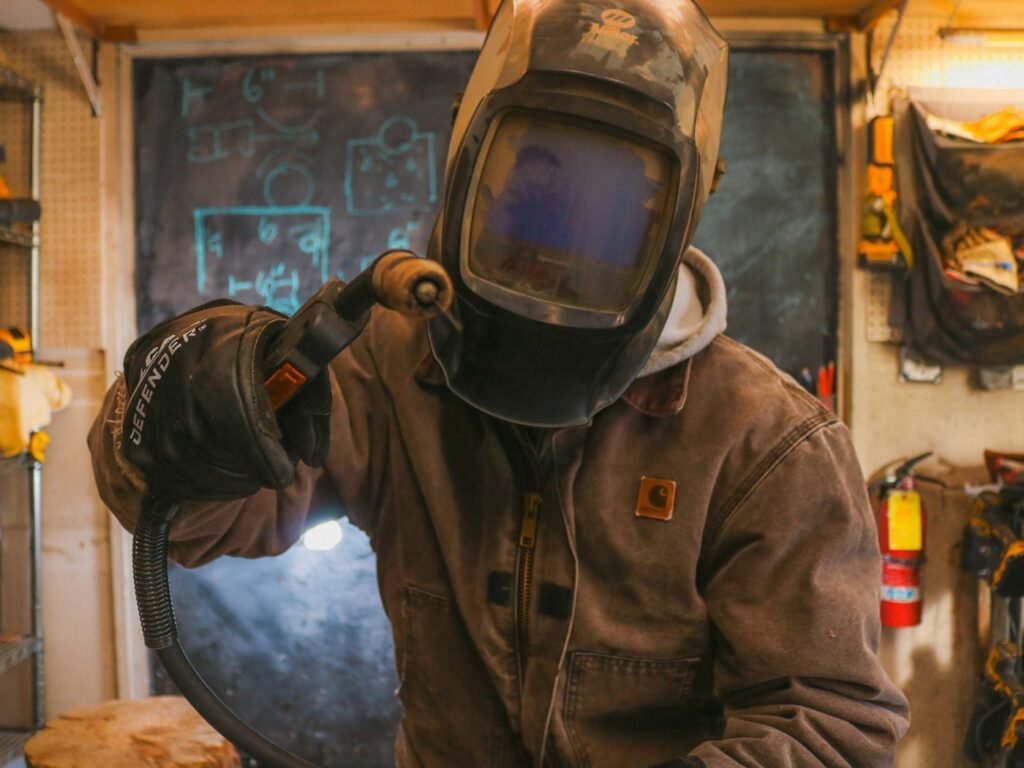
Choosing between a PAPR vs full face respirator comes down to protection factor, the wearer’s face and the heat: a powered air-purifying respirator with a loose-fitting hood or helmet needs no fit test, works with beards, cools the face and carries an assigned protection factor (APF) of 25 in the US system (TH2 under EN 12941), while a tight-fitting full-face respirator gives an APF of 50 (EN 136 Class 2 with P3 filters) but requires a clean-shaven face, annual fit testing and more effort to breathe through.
For long shifts in UAE and Saudi heat, grinding and welding in fabrication yards, and workforces where fit testing is impractical, PAPR is usually the better choice; for the highest particulate and gas exposures with a trained, fit-tested crew, the full-face respirator remains the stronger option.
How each device works
A full-face respirator relies on the wearer’s lungs to draw air through filters, creating negative pressure inside the mask. Any leak at the seal pulls contaminated air in. A PAPR uses a battery-powered blower on the belt to push filtered air through a hose into a hood, helmet, visor or tight-fitting mask, creating positive pressure that pushes outward through any gap. The blower does the breathing work, which is why PAPRs are more comfortable over an eight or ten hour shift.
Comparison table
| Factor | Full-face respirator (EN 136 / EN 143 P3) | PAPR (EN 12941 TH2/TH3 or EN 12942 TM3) |
|---|---|---|
| Assigned protection factor (US OSHA) | 50 | 25 (loose hood/helmet), 1,000 (tight-fitting TM3 or NIOSH tight-fit) |
| UK/EU APF (BS EN 529) | 40 with P3 | 20 (TH2), 40 (TH3), 40 (TM3) |
| Fit testing | Required, annually and on mask change | Not required for loose-fitting headtops; required for tight-fitting masks |
| Facial hair | Not permitted | Permitted with hoods and helmets |
| Breathing resistance | Noticeable, increases as filters load | None; air is supplied |
| Heat comfort | Poor in high heat; visor fogging | Good; constant airflow over face |
| Weight | 500 to 700 g on the face | 1 to 1.5 kg on the belt |
| Initial cost | Low | High |
| Running cost | Filters only | Filters, batteries, hoses, headtop visors |
| Oxygen-deficient or IDLH use | Never | Never |
Note that neither device is suitable for oxygen-deficient atmospheres or unknown concentrations; those require supplied-air respirators or SCBA.
Seven factors that decide the choice
- 1. Hazard and concentration. Calculate the required protection factor from the exposure and the occupational exposure limit. Welding fume, silica from concrete cutting, cement dust and pharmaceutical powders are usually within PAPR range; high solvent vapours may need a full-face mask with combined gas filters or an airline.
- 2. Beards and fit. Many GCC workforces include men who will not shave. A hood PAPR solves this without a compliance argument.
- 3. Heat. Above 35 degrees Celsius a full-face mask becomes hard to tolerate; PAPR airflow reduces heat stress and visor fogging, and some helmets integrate with welding shields and hard hats.
- 4. Shift length. For two hours, a full-face mask is fine; for eight, PAPR comfort means workers actually keep it on.
- 5. Integration. Welding and grinding headtops combine eye, face, head and respiratory protection in one unit, replacing separate welding helmets, goggles and masks.
- 6. Logistics. PAPR needs charging stations, spare batteries and airflow checks each shift. A remote pipeline camp without reliable power favours the simpler mask.
- 7. Budget. PAPR costs several times a full-face mask up front, but lower fit-testing cost, better compliance and fewer breaks often make it cheaper per productive hour.
Standards and markings to look for
PAPR with hoods and helmets are classified under EN 12941 as TH1, TH2 or TH3 (TH3 is the highest); PAPR with tight-fitting masks under EN 12942 as TM1 to TM3. Filters carry P (particle), A, B, E, K (gas) and combined markings. In the US, NIOSH approval under 42 CFR 84 with HE filters applies. Abu Dhabi OSHAD and Dubai Municipality accept both EN and NIOSH approvals, and operator specifications such as Aramco’s typically call for EN or NIOSH certified equipment with a written respiratory protection programme.
Daily checks and maintenance
For a PAPR: check the airflow with the manufacturer’s flow indicator before each use, confirm the battery is charged for the shift length, inspect the hose and headtop seal, and replace the visor cover when scratched. Filters are changed on the schedule or when the low-flow alarm sounds. For a full-face mask: inspect the visor, valves and straps, perform a negative-pressure seal check on each donning, and store in a sealed bag away from dust and sun. Both need cleaning and disinfection if shared, though masks should be individually issued.
Common mistakes on regional sites
Buying PAPR to avoid fit testing but issuing tight-fitting masks with it. Allowing beards with full-face masks. Charging batteries in a hot container, which shortens their life. Using P2 filters where P3 is specified. Expecting a PAPR to protect in a tank with unknown vapours. Forgetting that a full-face mask also provides eye protection, and removing goggles when switching to a half mask.
In hot conditions the PAPR vs full face respirator question often turns on breathing effort and heat build-up. Check the assigned protection factor needed before deciding PAPR vs full face respirator for the task. Fit testing, battery management and filter supply all affect the PAPR vs full face respirator choice.
Related guides: Full Face vs Half Mask Respirator: 7 Factors for UAE Sites · Airline Respirator Breathing Air Quality Requirements: 6 Checks · Respirator Cartridge Change Schedule: 5 Rules for UAE Sites
Key takeaways: PAPR vs Full Face Respirator
- Full-face: APF 50, requires clean-shaven face and annual fit test, lower cost.
- PAPR: APF 25 with hoods, no fit test, beard-compatible, far more comfortable in heat.
- Neither works in oxygen-deficient or IDLH atmospheres.
- Calculate required protection from exposure data before choosing.
- Factor in batteries, charging and filter logistics for PAPR.
Al Baraka Diyar supplies EN 12941 and NIOSH-approved powered air-purifying respirators with welding, grinding and general-purpose headtops, as well as full-face masks and filters, to contractors in the UAE, with service to Saudi Arabia and India. Browse the safety products catalogue or contact us with your task and exposure details for a recommendation.
Papr Vs Full Face Respirator: practical summary

This guide to papr vs full face respirator is written for UAE work sites, and also applies to our service areas in Saudi Arabia and India. If you need help applying papr vs full face respirator on your site, our team can confirm the right option and supply certified stock from the safety products range, or you can request a quotation. For the underlying standards, see the International Organization for Standardization.
Frequently asked questions
Does a PAPR need a fit test?
Not when used with a loose-fitting hood, helmet or visor, which is why they suit bearded workers and large crews. A PAPR used with a tight-fitting half or full-face mask (EN 12942) does require fit testing, exactly like a negative-pressure respirator.
Is a PAPR safer than a full-face respirator?
Not automatically. A fit-tested full-face mask with P3 filters has a higher assigned protection factor (50) than a hood PAPR (25). PAPR is safer in practice when fit is uncertain, shifts are long or heat makes workers remove masks. Match the device to the calculated required protection factor.
How long does a PAPR battery last in Gulf heat?
Most lithium-ion packs run eight to twelve hours at standard flow, but high ambient temperatures and heavily loaded filters reduce this. Charge batteries in an air-conditioned room, carry a spare for ten-hour shifts, and replace packs that no longer complete a shift.