

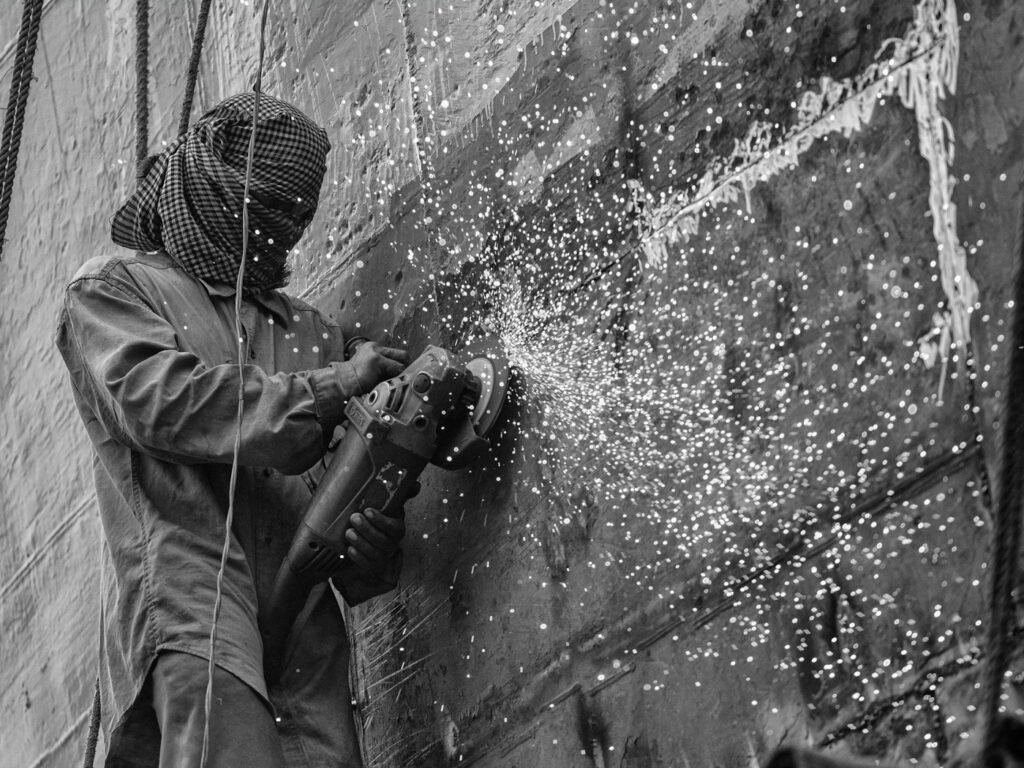
Airline respirator breathing air quality requirements are defined by EN 12021 in Europe and the GCC, and by CGA G-7.1 Grade D in US-specified sites: the air supplied to a hose-line respirator must contain 19.5 to 23.5 percent oxygen, less than 5 ppm carbon monoxide (EN 12021) or 10 ppm (Grade D), less than 500 ppm carbon dioxide, less than 0.5 mg/m3 oil mist, no significant odour and a controlled dew point. Abrasive blasting, spray painting, tank coating and asbestos removal contractors in the UAE and Saudi Arabia must test and document their breathing air at least quarterly and fit a carbon monoxide alarm on every system.
Where supplied-air respirators are used
Supplied-air (airline) respirators deliver clean air from a remote source through a hose to a full-face mask, half mask, hood or helmet. They are the standard choice for abrasive blasting in fabrication yards and tank farms, two-pack and isocyanate paint spraying, tank lining, long-duration confined-space work and some pharmaceutical and chemical handling. Compared with SCBA they allow hours of work without cylinder changes; compared with filtering respirators they protect against gases that filters cannot remove and against oxygen deficiency when combined with an escape cylinder.
Purity limits: EN 12021 versus Grade D
| Parameter | EN 12021 | CGA Grade D |
|---|---|---|
| Oxygen | 21% (plus or minus 1%) | 19.5% to 23.5% |
| Carbon monoxide | 5 ppm max | 10 ppm max |
| Carbon dioxide | 500 ppm max | 1,000 ppm max |
| Oil (mist and vapour) | 0.5 mg/m3 max | 5 mg/m3 max (condensed hydrocarbons) |
| Water / dew point | Below ambient use temperature; defined by pressure | No free liquid water; pronounced odour prohibited |
EN 12021 is the stricter of the two, and most GCC operator specifications and Dubai Municipality blasting and coating guidelines reference it. Where a contract specification says ‘Grade D’, EN 12021 air will comply.
Air source and filtration
Two sources are common: an oil-lubricated or oil-free compressor dedicated to breathing air, or a plant-air supply passed through a breathing air filtration unit. Either way the system needs:
- A compressor intake positioned upwind of exhausts, generators, blasting dust and paint overspray, at least several metres from any vehicle or engine.
- A multi-stage filtration panel: water separator, coalescing filters for oil, activated carbon for odours and vapours, and ideally a catalytic converter stage to oxidise carbon monoxide.
- A pressure regulator and gauge set to the respirator’s rated supply pressure range.
- A continuous carbon monoxide monitor with audible and visual alarm at the point of use or the filtration panel. CO from a hot compressor or exhaust ingestion is the main cause of fatalities on airline systems.
- A high-temperature alarm on oil-lubricated compressors, since overheating generates CO.
Hose length, pressure and the escape cylinder
Each respirator is approved for a maximum hose length (commonly 90 metres or 300 feet) and a pressure range at the point of connection. Running beyond the approved length or coupling hoses from different manufacturers drops the pressure below the demand valve’s requirement and the mask goes negative. Hoses must be non-kinking, chemically resistant and clearly marked as breathing air with incompatible couplings so they cannot be connected to tool air. For IDLH or confined-space use, a supplied-air set with an auxiliary escape cylinder (EN 14593 or EN 14594 combined type) is required so the wearer can exit if the supply fails.
Testing frequency and records
Test breathing air quality on installation, after any maintenance of the compressor or filters, and at least quarterly thereafter. Many Aramco, ADNOC and fabrication-yard HSE procedures require monthly testing on mobile units. Use a laboratory or a detector-tube test kit covering O2, CO, CO2, oil mist and water, and keep the certificate with the system. Filter elements have a rated life in hours or months; log changes. The CO monitor needs its own bump test and calibration like any gas detector.
GCC heat and humidity
Compressors in Jebel Ali or Jubail yards in August ingest air at 45 degrees Celsius and 80 percent humidity, which overloads water separators and raises outlet temperature. Size the dryer for summer conditions, shade the compressor, and consider a vortex cooler or air chiller at the mask, which also reduces heat stress for blasters working inside tanks. Schedule the hottest work outside 12:30 to 15:00 during the 15 June to 15 September midday-break period where it is outdoors.
Common mistakes
Taking breathing air from the same compressor as blasting air without filtration. Positioning the intake next to the generator. No CO monitor. Hoses stretched beyond approved length. Using an airline set without an escape cylinder for confined-space entry. Skipping quarterly tests because the air ‘smells fine’. Mixing mask and hose brands. Blasters removing the hood for a moment because they are hot. For short-duration work in lower hazards a powered air-purifying respirator may be a practical alternative where filters are suitable, and full-face filtering respirators remain the choice for brief tasks with known contaminants.
Airline respirator breathing air quality must be tested against the grade your standard requires, including oil, water, CO and CO2. Schedule airline respirator breathing air quality checks at the compressor and at the point of use. Keep test records so airline respirator breathing air quality can be proven during audits.
Related guides: PAPR vs Full Face Respirator: Which to Choose for Hot Sites · EEBD vs SCBA: When to Use an Escape Breathing Set (5 Rules) · Full Face vs Half Mask Respirator: 7 Factors for UAE Sites
Key takeaways: Airline Respirator Breathing Air Quality
- Breathing air must meet EN 12021 (or Grade D as a minimum): oxygen, CO, CO2, oil and water limits.
- Fit a CO alarm on every system and keep the intake away from exhausts.
- Respect the approved hose length and pressure range; never mix manufacturers.
- Use a combined set with escape cylinder for confined spaces or IDLH work.
- Test air quality quarterly at minimum and keep certificates on file.
Al Baraka Diyar supplies complete supplied-air airline respirator systems with filtration panels, CO monitors, hoses and masks or hoods for blasting, painting and confined-space contractors in the UAE, with service to Saudi Arabia and India. See the safety products catalogue or contact us to configure a system for your air source and number of wearers.
Airline Respirator Breathing Air Quality: practical summary
This guide to airline respirator breathing air quality is written for UAE work sites, and also applies to our service areas in Saudi Arabia and India. If you need help applying airline respirator breathing air quality on your site, our team can confirm the right option and supply certified stock from the safety products range, or you can request a quotation. For the underlying standards, see the International Organization for Standardization.
Frequently asked questions
How often should breathing air for airline respirators be tested?
At installation, after any compressor or filter maintenance, and at least every three months in normal use. Many GCC operator and yard procedures require monthly tests for mobile units. Keep each certificate with the system and log filter changes and CO monitor calibrations alongside it.
Can plant compressed air be used for supplied-air respirators?
Only after passing through a dedicated breathing-air filtration panel with water separation, oil coalescing, activated carbon and a CO monitor, and only if the resulting air is tested to EN 12021. Untreated plant air frequently contains oil mist, water and carbon monoxide and must never be connected directly.
Do airline respirators need an escape cylinder?
For confined-space entry, IDLH atmospheres or any situation where supply failure would be immediately dangerous, yes. Combined sets to EN 14593 or EN 14594 include a small cylinder giving several minutes of air to exit. For open-air blasting or painting with a reliable supply, a standard airline set is acceptable.