

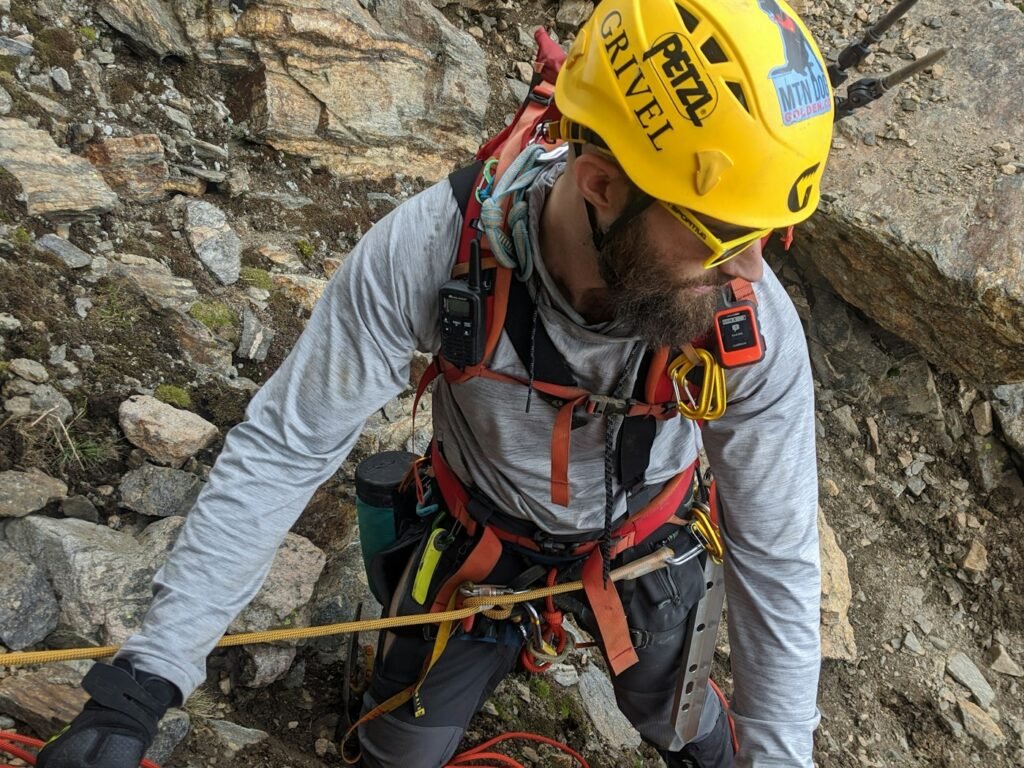
The EN 397 vs EN 12492 helmet difference is mainly about the chin strap and side protection: EN 397 industrial helmets have a strap that releases at 15 to 25 daN so the helmet cannot strangle a worker caught on machinery, while EN 12492 mountaineering-style helmets have a strap that holds to at least 50 daN and a shell tested for front, side and rear impacts. For work at height, where a helmet that stays on during a fall is more valuable than one that releases, the EN 12492 or ANSI Type II design is the right choice.
Why it matters on UAE and Saudi sites
Scaffolders, riggers, rope-access technicians and steel erectors in the GCC fall sideways and tumble, not straight down. Investigations repeatedly find the EN 397 hard hat lying some distance from the casualty. Abu Dhabi OSHAD CoP 23, Dubai Municipality and Saudi Aramco CSM all require head protection that remains in place during work at height, and most ADNOC contractors now specify a four-point chin strap for anyone above 1.8 m. Large main contractors in Dubai and Riyadh have moved whole workforces onto climbing-style helmets for exactly this reason.
Standards explained
- EN 397:2012+A1:2012 — industrial safety helmets; crown impact 49 J, penetration test, optional lateral deformation, 440 V electrical, -30°C and +150°C options. Chin strap releases between 150 N and 250 N.
- EN 12492:2012 — helmets for mountaineers; crown, front, side and rear impacts, penetration, and a chin strap holding at least 500 N with no more than 25 mm stretch.
- EN 14052:2012 — high-performance industrial helmets, a stricter alternative to EN 397 with side impact and a stronger retention system.
- ANSI/ISEA Z89.1-2014 — Type I (top impact only) and Type II (top and lateral impact); Class G, E and C for electrical rating.
Many height-work helmets are now dual-certified to EN 397 and EN 12492, satisfying industrial requirements while keeping the strong strap.
Comparison table
| Feature | EN 397 industrial | EN 12492 climbing-style | ANSI Z89.1 Type II |
|---|---|---|---|
| Chin strap release | 15–25 daN (releases) | Holds to 50 daN | Not specified; usually strong |
| Impact zones tested | Crown (lateral optional) | Crown, front, sides, rear | Crown and lateral |
| Ventilation | Optional; affects electrical rating | Usually vented | Vented versions are Class C |
| Electrical rating | 440 V a.c. option | None | Class E 20 kV, Class G 2.2 kV |
| Stays on during a fall | Unlikely | Yes | Typically yes |
| Typical weight | 350–450 g | 350–450 g | 400–500 g |
How to choose a height-work helmet
Match the hazard
If the task involves electrical work, specify EN 397 with the 440 V option or an unvented ANSI Class E helmet. If the task is purely working at height, a vented EN 12492 or dual-certified helmet with a four-point strap is better. Many sites pair the height-work helmet with the same full-body harness issue so that anyone wearing a harness is automatically wearing the right helmet.
Heat
Vented shells and moisture-wicking liners reduce heat build-up, which matters during the UAE midday-break period of 15 June to 15 September (12:30 to 15:00) when work resumes in the hottest part of the day. Light-coloured shells reflect more radiant heat. Check that the vents can be closed where dust or sparks are present.
Accessories
Look for integrated slots for ear muffs, visors and head torches, a reflective sticker set for night work, and a ratchet adjuster that can be operated with gloves.
Common mistakes
- Issuing EN 397 helmets with a loose or unfastened strap for scaffolding work.
- Using a vented climbing helmet near live electrical equipment.
- Drilling holes to fit lamps or badges, which voids certification.
- Stickers and paint on the shell that hide cracks or react with the polymer.
- Assuming an EN 12492 helmet alone satisfies an industrial PPE specification that calls for EN 397.
Maintenance and replacement
Inspect the shell daily for cracks, chalking and deformation, and the strap for fraying. Replace any helmet that has taken an impact. Manufacturers typically state a service life of three to five years from first use, and shorter in high-UV environments; a date wheel moulded into the shell makes this easy to check. Store out of direct sun; a helmet left on a pickup dashboard in August reaches temperatures that accelerate shell ageing.
Cost factors
Dual-certified height-work helmets cost several times a basic EN 397 hard hat, but they last longer, reduce lost helmets from falls and can be fitted with integrated eye and hearing protection, which offsets separate purchases.
The EN 397 vs EN 12492 choice comes down to whether the helmet must stay on during a fall and protect from side impacts. For work at height and rescue teams, the EN 397 vs EN 12492 answer is usually EN 12492 with a secure chin strap. Record the EN 397 vs EN 12492 rule per task in your PPE matrix so issue is consistent.
Crews working from a man lift or other elevated platform are usually issued EN 12492 helmets with a secure chin strap, so the helmet stays on if they are thrown or jolted.
Related guides: How to Choose a Safety Helmet for Construction in UAE: 7 Checks · Bump Cap vs Hard Hat: 5 Differences Every UAE Site Must Know · Auto-Darkening Welding Helmet Shade Guide for GCC Workshops
Key takeaways: EN 397 vs EN 12492
- EN 397 straps release; EN 12492 straps hold. Height work needs the one that holds.
- Dual-certified EN 397 + EN 12492 helmets satisfy most GCC specifications.
- Choose unvented, electrically rated helmets near live equipment.
- Ventilation and light colours help during Gulf summers.
- Replace after impact or at the manufacturer’s stated service life.
Al Baraka Diyar supplies vented, dual-certified Type II and EN 12492 height-work helmets and the wider safety products range to contractors across the UAE, with service to Saudi Arabia and India. To discuss a site-wide helmet specification, contact us.
En 397 Vs En 12492: practical summary
This guide to en 397 vs en 12492 is written for UAE work sites, and also applies to our service areas in Saudi Arabia and India. If you need help applying en 397 vs en 12492 on your site, our team can confirm the right option and supply certified stock from the safety products range, or you can request a quotation. For the underlying standards, see the International Organization for Standardization.
Frequently asked questions
Is an EN 12492 helmet legal for construction work in the UAE?
Yes, provided the site specification accepts it. Most ADNOC, Aramco and main-contractor standards accept EN 12492 or ANSI Type II helmets for work at height, and many now prefer them. Choosing a model dual-certified to EN 397 removes any doubt during PPE audits.
Why does an EN 397 chin strap release so easily?
EN 397 limits the strap to a release force of 15 to 25 daN so that a helmet caught in machinery or on a projection does not strangle the wearer. That safeguard is right for ground-level industrial work but means the helmet often comes off during a fall.
Can I wear a vented climbing helmet for electrical work?
No. Vents allow contact with live parts, and EN 12492 helmets carry no electrical rating. For electrical tasks use an unvented EN 397 helmet with the 440 V option or an ANSI Z89.1 Class E helmet, and follow the site's arc-flash PPE requirements.