

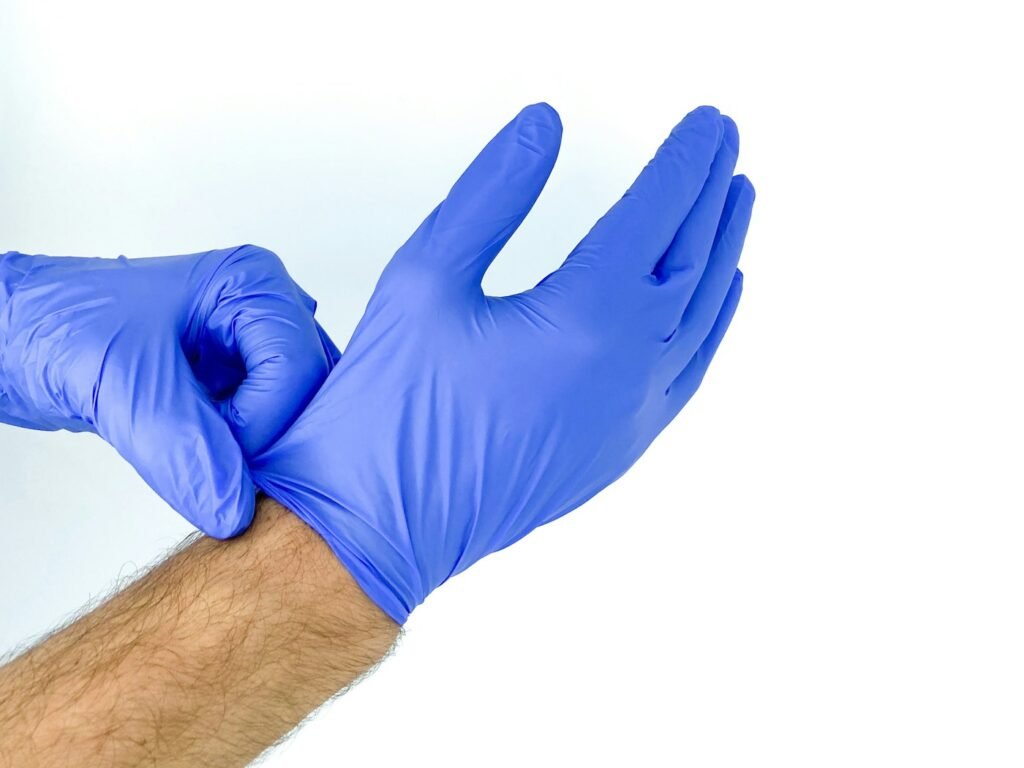
In the nitrile vs latex vs vinyl disposable gloves debate, nitrile wins for most industrial, laboratory and food-handling use in the GCC because it is latex-allergy free, puncture resistant and gives useful short-term splash protection against oils and many chemicals. Latex offers the best fit and tactile feel but carries protein-allergy risk; vinyl is the cheapest but tears easily and gives almost no chemical resistance, so it should be limited to low-risk, short-duration tasks.
Why disposable glove choice matters in the GCC
Disposable gloves are consumed in enormous quantities across UAE and Saudi facilities: clinics, catering, laboratories, paint shops, maintenance workshops and oilfield sampling. Buying on price alone leads to high tear rates, latex sensitisation among staff and false confidence when handling chemicals. Dubai Municipality food safety rules, DHA and MOHAP healthcare standards, and ADNOC and Saudi Aramco HSE programmes all expect gloves suitable for the task, and in healthcare and food settings latex-free policies are now common.
Standards explained
Three standards matter. EN 455 parts 1 to 4 (medical gloves for single use) covers freedom from holes (AQL 1.5 or better), physical properties such as tensile strength and elongation, biological safety including latex protein content, and shelf life. EN ISO 374-1 and 374-5 cover chemical and micro-organism protection; a disposable glove marked Type B or C with code letters has passed permeation testing against specific chemicals. EN 1186 and Regulation (EC) 1935/2004 cover food contact. In the US the reference is ASTM D6319 (nitrile), D3578 (latex) and D5250 (vinyl), plus FDA 21 CFR 177 for food contact. A medical examination glove is not automatically a chemical glove; look for both marks if both uses are intended.
Comparison table
| Property | Nitrile | Latex (natural rubber) | Vinyl (PVC) |
|---|---|---|---|
| Allergy risk | Very low (accelerator-free grades available) | Latex protein allergy risk | Very low |
| Puncture resistance | High | Medium | Low |
| Elasticity and fit | Good; improves with warmth | Excellent | Poor; loose fit |
| Oil and fuel splash | Good | Poor | Poor |
| Acid and caustic splash (dilute) | Good | Fair | Fair |
| Solvent splash | Fair (short exposure) | Poor | Very poor |
| Typical thickness | 0.08 to 0.15 mm | 0.10 to 0.18 mm | 0.08 to 0.12 mm |
| Shelf life (cool storage) | 3 to 5 years | 3 years | 5 years |
| Relative cost | Medium | Medium | Low |
| Best for | Workshops, labs, healthcare, food, oilfield sampling | Precision clinical tasks where no allergy risk | Light food prep, cleaning, short tasks |
How to choose for your application
Maintenance and mechanical workshops
Choose 0.12 to 0.15 mm nitrile with a textured fingertip and a longer 30 cm cuff. Oil and grease resistance plus puncture strength matter more than feel. Black or orange nitrile hides grime and makes tears visible.
Laboratories and sampling
Nitrile with EN ISO 374 Type B or C marking and a low AQL (0.65 or 1.0). Change gloves immediately after any solvent splash; disposable nitrile is not a replacement for reusable chemical-resistant gloves for immersion work.
Healthcare and first aid
EN 455 examination gloves, nitrile preferred for latex-free policy, powder-free, AQL 1.5 or better. Keep a stock in every first aid kit.
Food handling and catering
Food-contact certified nitrile or vinyl, blue for visibility against food. Vinyl is acceptable for brief, low-risk tasks such as sandwich assembly; nitrile for anything involving oils, cleaning chemicals or long shifts.
Common mistakes
- Treating disposable gloves as chemical protection; most permeate within minutes against solvents.
- Double-gloving with vinyl to compensate for tearing instead of switching to nitrile.
- Buying latex for a mixed workforce without an allergy policy.
- Storing cartons in unconditioned warehouses, where heat and ozone shorten shelf life dramatically; natural rubber is worst affected.
- Reusing single-use gloves, which cross-contaminates and spreads chemicals.
- Ignoring sizing; a glove one size too small tears at the thumb crotch on donning.
Storage and shelf life in Gulf conditions
Disposable gloves degrade with heat, UV light and ozone. Store cartons below 30 °C in the dark, away from electric motors and welding bays that generate ozone. Rotate stock first in, first out and check the expiry date on each box. In an uncooled container yard in July, a three-year latex shelf life can effectively halve. Nitrile tolerates heat better than latex but still stiffens and loses elongation.
Cost factors
Unit cost depends on polymer, thickness, AQL, certification set and order volume. Vinyl is cheapest per glove but often most expensive per task because of tearing. Accelerator-free and extended-cuff nitrile carry a premium. For sites consuming tens of thousands of gloves per month, specifying a single nitrile grade with both EN 455 and EN ISO 374 marks simplifies procurement and covers most uses.
The nitrile vs latex vs vinyl choice depends on chemical risk, allergy risk and task length. Nitrile usually wins the nitrile vs latex vs vinyl comparison for industrial use. Review nitrile vs latex vs vinyl stock against your actual tasks.
Related guides: Nitrile vs PU Coated Gloves for Construction: 5 Key Differences · How to Choose Welding Gloves for MIG, TIG and Stick: 5 Rules · Best Rigger Gloves for Lifting Operations: 6 Things to Check
Key takeaways: Nitrile vs Latex vs Vinyl
- Nitrile is the default for industrial, laboratory and most healthcare use in the GCC.
- Latex gives the best feel but needs an allergy policy.
- Vinyl is for low-risk, short tasks only.
- Check for EN 455 and EN ISO 374 marks according to use.
- Store cool and dark; Gulf heat shortens shelf life.
Al Baraka Diyar supplies disposable nitrile and latex gloves by the carton for workshops, laboratories, clinics and catering across the UAE, with service to Saudi Arabia and India, alongside the complete range of safety products. Contact us for bulk pricing and samples.
Nitrile Vs Latex Vs Vinyl: practical summary
This guide to nitrile vs latex vs vinyl is written for UAE work sites, and also applies to our service areas in Saudi Arabia and India. If you need help applying nitrile vs latex vs vinyl on your site, our team can confirm the right option and supply certified stock from the safety products range, or you can request a quotation. For the underlying standards, see the International Organization for Standardization.
Frequently asked questions
Are nitrile gloves better than latex?
For most workplaces, yes. Nitrile is latex-protein free, more puncture resistant and gives better oil and splash resistance. Latex offers slightly better elasticity and feel, which matters mainly in clinical settings where no staff have latex allergy.
What does AQL mean on a glove box?
Acceptable Quality Level is the statistical limit on pinholes in a batch. AQL 1.5 is the EN 455 requirement for medical gloves; AQL 0.65 or 1.0 indicates tighter control. Lower numbers mean fewer defective gloves.
Can disposable nitrile gloves protect against chemicals?
Only against brief splashes of some chemicals, and only if marked to EN ISO 374-1 Type B or C. They permeate quickly against solvents such as acetone and toluene. For immersion or prolonged contact use thicker reusable chemical gloves.