


Knowing how to choose welding gloves for MIG TIG and stick welding starts with EN 12477: Type A gloves are heavier and built for stick (MMA) and MIG/MAG where spatter and radiant heat are high, while Type B gloves are thinner and more dexterous for TIG, where the welder needs to feed filler wire by hand. Match the type to the process, the leather to the heat load, and the cuff length to the position of the work.
Why welding glove choice matters on GCC fabrication yards
Fabrication yards in Jubail, Dammam, Abu Dhabi and Sharjah run welding around the clock on structural steel, pipe spools and pressure vessels. Burns to the hands and forearms are among the most common hot-work injuries, and most are caused by gloves that are too short, too thin for the process or worn beyond their life. Saudi Aramco’s Construction Safety Manual hot-work requirements, ADNOC HSE standards and Dubai Municipality’s construction safety code all require process-appropriate PPE for welders, and inspectors increasingly look for the EN 12477 marking rather than a generic leather glove.
Standards explained: EN 12477, EN 407 and EN 388
EN 12477:2001 + A1:2005 is the welders’ glove standard. It references EN 388 for mechanical performance and EN 407 for thermal performance, and sets minimum levels for each type. Type A gloves must achieve higher abrasion, tear, burning behaviour, contact heat and convective heat levels; Type B gloves have lower minimums but must offer better dexterity (EN 420 level 5). EN 407:2020 gives a six-digit thermal code: burning behaviour, contact heat, convective heat, radiant heat, small molten metal splash and large molten metal splash, each rated 1 to 4. A typical Type A gauntlet reads 413X4X; a Type B TIG glove reads 212X2X. In North America the reference is ANSI/ISEA 105 for mechanical and ASTM F1060 for contact heat.
Matching glove to process
| Process | EN 12477 type | Leather | Cuff length | Key feature |
|---|---|---|---|---|
| Stick / MMA | Type A | Cow split, 1.2 to 1.4 mm, lined | 35 to 40 cm | Heavy spatter resistance, Kevlar stitching |
| MIG / MAG | Type A | Cow or goat split with grain palm | 30 to 35 cm | Reinforced thumb and palm for torch grip |
| TIG / GTAW | Type B | Goat or deer grain, 0.7 to 0.9 mm, unlined | 25 to 30 cm | Fingertip sensitivity for filler wire |
| Flux-cored, gouging | Type A | Heavy cow split, aluminised back optional | 40 cm or more | Radiant heat and large splash rating |
| Plasma and oxy-fuel cutting | Type A | Cow split, lined | 35 cm | Molten metal splash level 3 or above |
How to choose: five rules
- Rule 1: process first. Do not issue TIG gloves to stick welders or vice versa. A Type B glove burns through on MMA; a Type A glove makes TIG wire feeding clumsy and the welder removes it.
- Rule 2: cuff to the position. Overhead and out-of-position welding sends spatter down the sleeve; specify the longer cuff and pair with leather sleeves and aprons.
- Rule 3: check the stitching. Kevlar thread does not burn; cotton thread fails first and the glove falls apart while the leather still looks fine.
- Rule 4: liner for Type A. A cotton or fleece liner adds contact-heat protection for hot workpieces. For TIG, go unlined for feel.
- Rule 5: size properly. Welding gloves run large; stock sizes 9 to 11 and let welders try them. A glove that is too long in the finger reduces torch control.
Leather types and heat behaviour
Cow split leather is the workhorse for Type A gauntlets: thick, heat tolerant and economical. Goat grain is thin, strong and supple, ideal for TIG. Deer grain stays soft after repeated heating and is the premium TIG choice. Pig grain resists moisture and is a good mid-range option. Elk or buffalo split is used for the heaviest gouging and foundry gloves. Chrome-tanned leather is standard; a chromium VI declaration below 3 mg/kg per EN ISO 21420 should be available from the supplier. Aluminised backs reflect radiant heat and are worth specifying for arc gouging and furnace work.
Common mistakes
Using general-purpose rigger gloves for welding is the most common and most dangerous error; the short cuff and cotton stitching give no forearm protection. Second is keeping gloves in service after they have gone hard and shiny from heat, when the leather has lost its insulating loft and cracks. Third is wetting gloves to cool them, which turns hot wet leather into a scald hazard. Fourth is ignoring EN 407 molten-splash levels for cutting work, where the glove sees more molten metal than in welding. Finally, buying the cheapest gauntlet in one size only leads to poor fit and higher consumption.
Heat stress and glove rotation in the Gulf
Welders in the GCC already carry a heavy heat load from helmets, leather jackets and shaded but unventilated bays. Choose the lightest glove that meets the process requirement, encourage rotation of two pairs, and dry gloves in shade. Hot work is normally indoors or under cover and is not directly covered by the UAE midday-break rule (15 June to 15 September, 12:30 to 15:00), so heat-stress controls such as cool rest areas and hydration remain the employer’s responsibility throughout the shift.
Choose welding gloves by process: thin for TIG, heavier for MIG and stick. Workers who choose welding gloves for dexterity alone risk burns. Check certification when you choose welding gloves for bulk issue.
Related guides: Best Rigger Gloves for Lifting Operations: 6 Things to Check · Nitrile vs PU Coated Gloves for Construction: 5 Key Differences · Nitrile vs Latex vs Vinyl Disposable Gloves: Which to Buy
Key takeaways: Choose Welding Gloves
- EN 12477 Type A for stick, MIG and cutting; Type B for TIG.
- Read the EN 407 code for contact heat and molten-splash levels.
- Longer cuffs and Kevlar stitching for overhead and heavy work.
- Retire gloves when the leather hardens or stitching opens.
- Never use rigger gloves for welding.
Al Baraka Diyar supplies EN 12477 welding gauntlets in Type A and Type B with Kevlar stitching, as well as welding helmets and the complete range of safety products for UAE, KSA and Indian fabrication yards. Contact us for samples and bulk pricing.
Choose Welding Gloves: practical summary
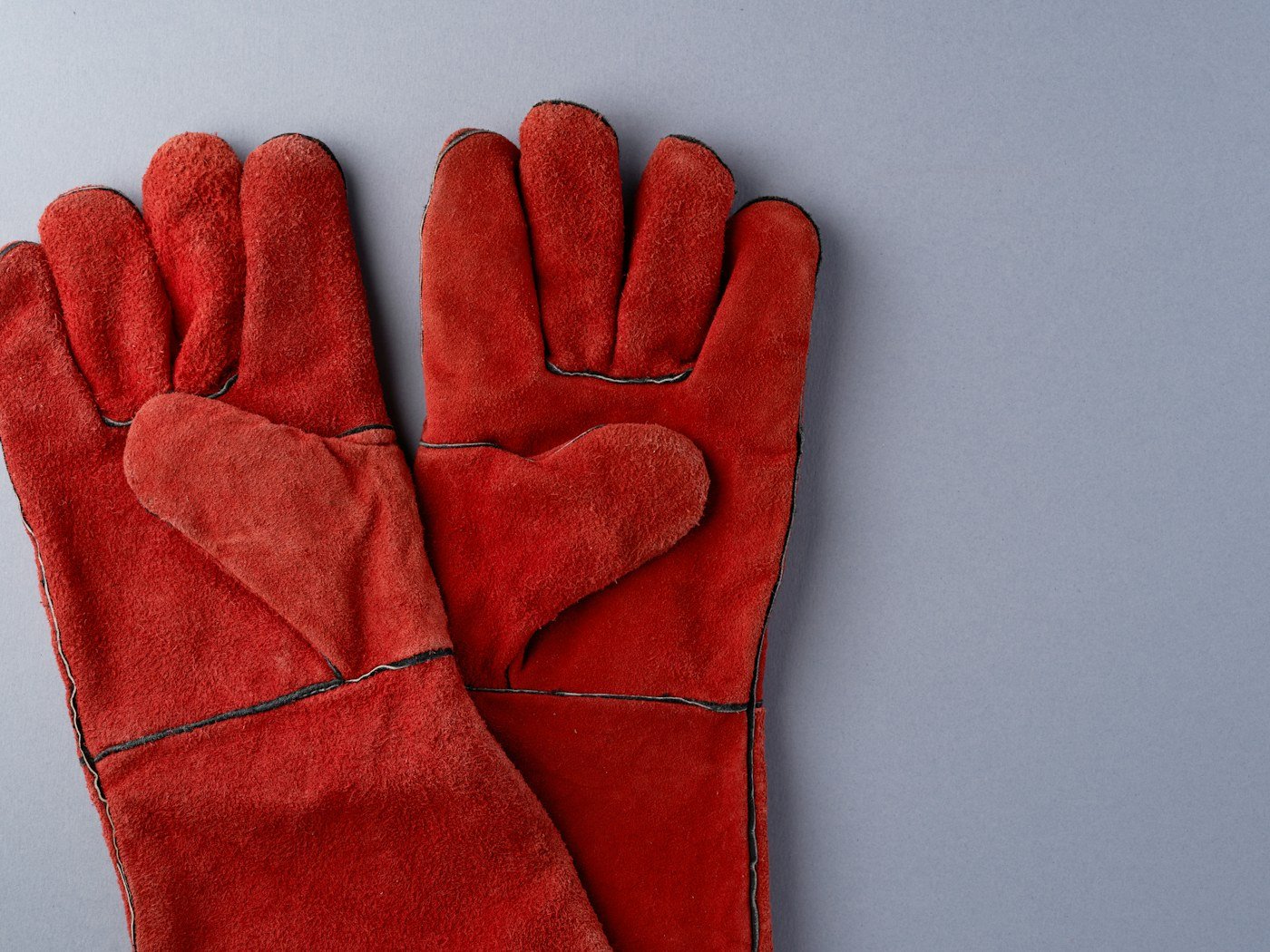
This guide to choose welding gloves is written for UAE work sites, and also applies to our service areas in Saudi Arabia and India. If you need help applying choose welding gloves on your site, our team can confirm the right option and supply certified stock from the safety products range, or you can request a quotation. For the underlying standards, see the International Organization for Standardization.
Frequently asked questions
What is the difference between Type A and Type B welding gloves?
Under EN 12477, Type A gloves have higher minimum mechanical and thermal performance for stick, MIG and cutting work. Type B gloves have lower minimums but higher dexterity, making them suitable for TIG welding where filler wire is fed by hand.
Can TIG gloves be used for MIG welding?
It is not recommended. TIG (Type B) gloves use thin goat or deer leather that burns through quickly under MIG spatter and radiant heat. Use a Type A glove with a grain palm for MIG and keep Type B gloves for TIG only.
How long should welding gloves last?
On a busy fabrication yard, Type A gauntlets typically last one to three weeks and TIG gloves one to two weeks. Replace gloves once the leather hardens, stitching opens or the palm thins, regardless of age.