

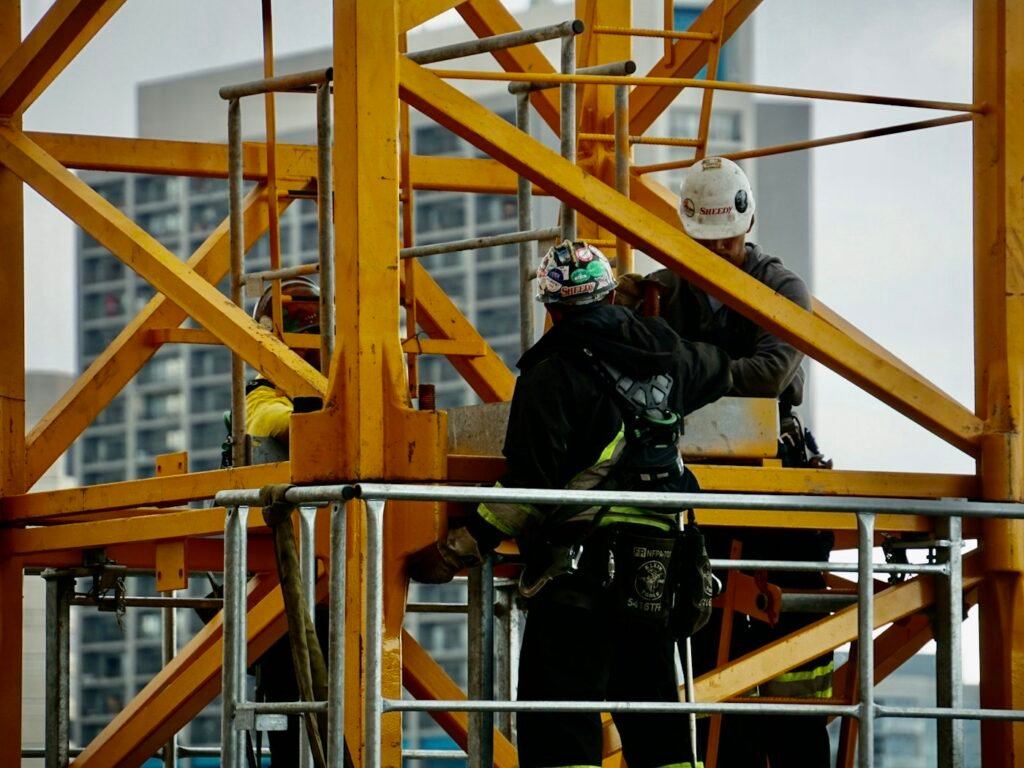
To inspect a safety harness, check the webbing, stitching, D-rings, buckles, adjusters and label in a fixed sequence before every use, and have a competent person carry out a documented periodic inspection at least every 12 months as required by EN 365. Any cut, fraying, chemical damage, deformed metal, missing label or deployed fall indicator means the harness is withdrawn from service immediately.
Falls from height remain the single largest cause of fatalities on construction sites in the UAE and Saudi Arabia, and a harness that has been damaged or has already arrested a fall may not survive a second one. This checklist explains what to look for, how often, and what to record.
Why harness inspection matters in the Gulf
Gulf conditions accelerate harness wear. Ultraviolet exposure degrades polyester and nylon webbing, fine sand works into stitching and buckles, and sweat salts stiffen fibres. Scaffolders, steel erectors and tank cleaners frequently use harnesses for a full shift, so wear accumulates quickly. Dubai Municipality’s construction safety code and the OSHAD System Framework in Abu Dhabi require employers to inspect fall-arrest equipment, and the Saudi Aramco Construction Safety Manual requires 100% tie-off with equipment inspected before each use and formally by a competent person, with records available to the Aramco proponent.
Standards and labels to verify
A compliant full-body harness will be labelled to EN 361 (fall arrest), and may also carry EN 358 (work positioning belt) or EN 813 (sit harness) markings if it has side or ventral attachment points. American-specified sites reference ANSI/ASSP Z359.11. The label must show the manufacturer, model, serial number, year of manufacture, standard, size and the CE or notified-body mark. If the label is missing or illegible, the harness cannot be traced and must be removed from service.
The 10-point inspection checklist
| Step | Component | Check for | Reject if |
|---|---|---|---|
| 1 | Label | Legibility, serial number, standard, date | Missing or unreadable |
| 2 | Webbing | Cuts, abrasion, burns, UV fading, chemical stiffness, mould | Any cut, fraying across more than a few threads, hardened or glazed areas |
| 3 | Stitching | Broken, pulled or missing stitches, especially around D-rings | Any broken load-bearing stitch |
| 4 | Fall indicator | Folded webbing stitch pack at dorsal D-ring | Deployed or torn open |
| 5 | Dorsal D-ring | Cracks, corrosion, distortion, free movement | Bent, cracked, pitted or seized |
| 6 | Sternal and side rings | Same as dorsal; correct attachment to webbing | Any deformation |
| 7 | Buckles and adjusters | Operation, spring return, burrs, corrosion | Will not lock, slips under load, corroded |
| 8 | Keepers and loops | Elastic keepers present, retaining tails | Missing, so webbing tails can snag |
| 9 | Hardware joins | Rivets, grommets, plastic sliders | Loose, missing or cracked |
| 10 | Fit and function | Dorsal ring between shoulder blades, leg straps snug, chest strap at sternum | Cannot be adjusted to fit the user |
Pre-use versus periodic inspection
The pre-use check is carried out by the wearer every time the harness is put on. It takes two to three minutes and follows the sequence above visually and by touch, running the webbing through the hands to feel for damage. The periodic inspection is a formal, documented examination by a competent person, independent of the wearer, at intervals set by the manufacturer and in any case not exceeding 12 months under EN 365. Many Gulf contractors inspect quarterly because of UV and sand exposure, and some clients require it monthly during shutdowns. A harness must also be inspected after any fall arrest, after exposure to chemicals or extreme heat, and if there is any doubt about its history.
Service life and storage
Most manufacturers state a maximum service life of ten years from the date of manufacture, with a shorter working life, often five years, once the harness is put into use, subject to inspection. Store harnesses hanging in a cool, dry, dark place away from solvents, welding sparks and direct sun. Never leave harnesses in the back of a pickup or on a scaffold deck overnight. Clean with mild soap and lukewarm water and air dry; do not use bleach, pressure washers or tumble dryers.
Records and tagging
Keep an inspection register with harness serial number, date of first use, inspection dates, inspector name and result. Colour-coded tags or RFID tags make the current status visible at the gate. Auditors in the UAE and Saudi Arabia routinely sample harnesses and ask for the matching record; a harness in use without a current inspection record is a common non-conformance.
Related guides: Restraint Lanyard vs Fall Arrest Lanyard: 5 Key Differences · Work at Height Rescue Plan Requirements: 5 Essentials · How to Install a Temporary Horizontal Lifeline: 6 Steps
Key takeaways
- Inspect before every use and formally at least every 12 months (EN 365), more often in Gulf conditions.
- Follow a fixed sequence: label, webbing, stitching, fall indicator, rings, buckles, keepers, fit.
- Reject any harness with cuts, broken stitching, deformed hardware, a missing label or a deployed fall indicator.
- Remove any harness that has arrested a fall and quarantine it until the manufacturer or competent person assesses it.
- Keep a register linking serial numbers to inspection dates and results.
Al Baraka Diyar supplies EN 361 and ANSI Z359.11 full-body safety harnesses with matching energy-absorbing and restraint lanyards to contractors across the UAE, with service to Saudi Arabia and India. Browse the complete safety products catalogue or contact us for inspection tags and bulk pricing.
Safety Harness: practical summary
This guide to safety harness is written for UAE work sites, and also applies to our service areas in Saudi Arabia and India. If you need help applying safety harness on your site, our team can confirm the right option and supply certified stock from the safety products range, or you can request a quotation. For the underlying standards, see the International Organization for Standardization.
Frequently asked questions
How often must a safety harness be formally inspected?
EN 365 requires a periodic inspection by a competent person at least every 12 months, or more frequently where the manufacturer or the risk assessment requires it. In the Gulf, many contractors inspect every three months because UV, sand and sweat accelerate webbing wear, and after any fall arrest.
Can a harness be used after it has arrested a fall?
No. A harness that has arrested a fall must be removed from service immediately, tagged and quarantined. Even if no damage is visible, the webbing and stitching have been shock-loaded and the fall indicator will usually have deployed. Only the manufacturer or an authorised competent person can decide whether it is returned to use.
What is the service life of a full body harness?
Most manufacturers allow up to ten years from the date of manufacture, with a typical working life of around five years once in use, provided the harness passes every inspection. Harsh Gulf conditions, chemical exposure or heavy daily use shorten this, and the label date and inspection record determine the actual limit.