

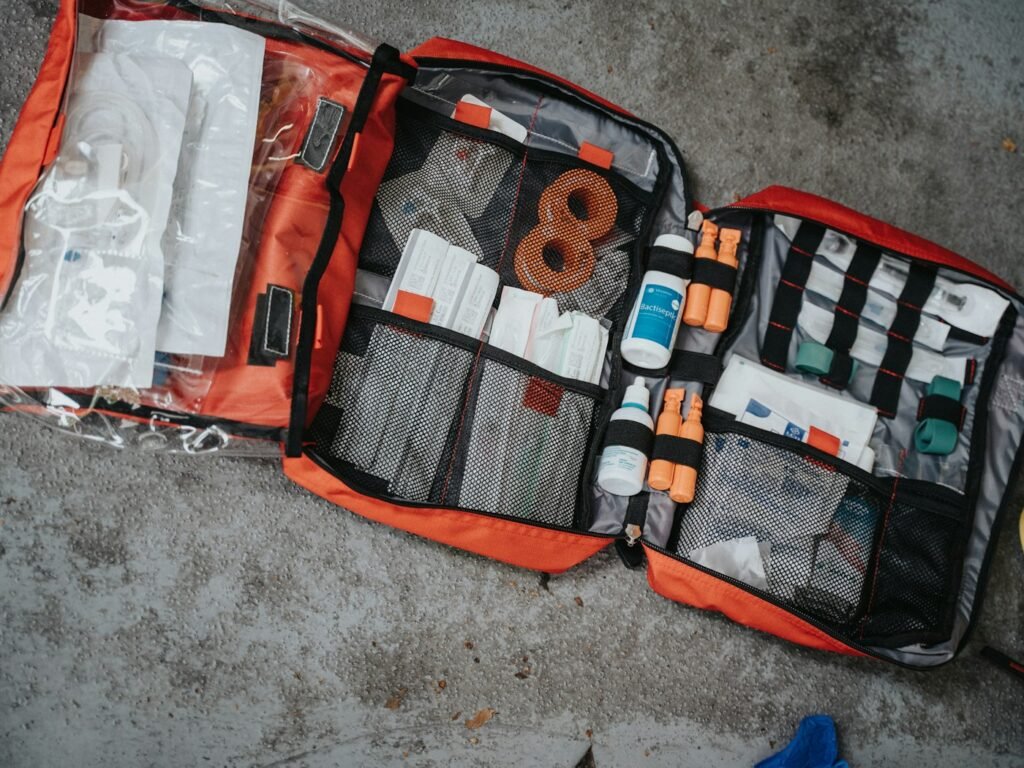
First aid kit requirements for construction sites in UAE are set by the employer’s risk assessment within the frameworks of Dubai Municipality, Abu Dhabi OSHAD and the federal labour law: every site must have first aid kits proportionate to the number of workers and hazards, a trained first aider on each shift, and emergency eyewash where chemicals, dust or welding create an eye-injury risk. In practice, sites follow the BS 8599-1 kit sizes (small, medium, large) matched to headcount and keep kits within a short walk of every work area.
This guide sets out what a compliant kit contains, how many you need, what eyewash provision looks like, and how to keep it all audit-ready in Gulf conditions.
Why first aid provision matters on GCC sites
Construction, fit-out and industrial maintenance in the UAE and Saudi Arabia involve cuts, crush injuries, burns, eye injuries from grinding and chemicals, and heat illness. Response in the first few minutes decides outcomes. Abu Dhabi’s OSHAD System Framework and Dubai Municipality’s Code of Construction Safety Practice both require employers to assess first aid needs, provide equipment and trained personnel, and record incidents. In Saudi Arabia, the Saudi Aramco Construction Safety Manual sets similar duties for contractors, including first aid stations on larger sites and ambulance arrangements for remote sites.
How many kits and what size
The UAE does not publish a fixed national contents list, so most contractors adopt BS 8599-1 (UK workplace first aid kits) or DIN 13157/13169 (German), both of which are accepted by auditors because they tie kit size to risk and headcount.
| Kit size (BS 8599-1) | Suggested headcount, higher-risk site | Typical placement |
|---|---|---|
| Small | Up to 25 workers | Site vehicles, small crews, welfare cabins |
| Medium | 25–100 workers | Each floor or zone of a building, workshops |
| Large | Over 100 workers, or one per 100 | Main first aid room or site office |
| Travel / vehicle | Per vehicle | Pickups, buses, remote survey teams |
A large kit typically contains sterile dressings in several sizes, adhesive plasters, eye pads, triangular bandages, conforming bandages, nitrile gloves, a foil blanket, burn dressings, a resuscitation face shield, shears, tape and a guidance leaflet. Add burn gel, instant cold packs and oral rehydration sachets for heat-stress response in Gulf summers, and consider an automated external defibrillator (AED) at the main first aid station on large sites.
First aiders and first aid rooms
Every shift needs at least one trained first aider; a common ratio is one per 50 workers on construction sites, with more where work is spread across several levels or remote areas. Training should be from a recognised provider (for example, courses approved by Dubai Corporation for Ambulance Services or the Saudi Red Crescent). Sites with more than around 150 workers usually provide a dedicated first aid room with a couch, hand-wash sink, lockable medicine cabinet and a record book, staffed by a nurse on larger sites.
Eyewash station requirements
Where there is a risk of chemical splash, dust, cement or welding spatter in the eyes, emergency eyewash is required. The widely applied benchmark is ANSI/ISEA Z358.1, which calls for an eyewash reachable within 10 seconds (about 16.8 m) on the same level with no obstructions, capable of flushing both eyes with tepid water (16–38 °C) for 15 minutes. EN 15154 is the European equivalent for plumbed and portable units. Options include:
- Plumbed eyewash or combination shower/eyewash in batching plants, laboratories, battery rooms and chemical stores; activate weekly and record it.
- Self-contained gravity-fed stations (around 30 litres) where no water supply exists; change the preserved water every three to six months.
- Portable eyewash bottles (500 ml to 1 litre, sterile saline) as a supplement for first response, not a substitute for 15-minute flushing.
In Gulf heat, water in exposed tanks can exceed 38 °C and will scald rather than soothe. Shade plumbed units and store gravity-fed stations out of direct sun.
Inspection, restocking and records
Check kits monthly against a contents list, replace used or expired items (saline, burn gel and dressings carry expiry dates), and seal the kit with a tamper tag. Keep a register of inspections and an accident book recording every treatment given, which OSHAD and Dubai Municipality inspectors can request. Mark kit locations with the ISO 7010 green-and-white first aid sign and post the first aider’s name and contact number beside it.
Common audit findings
Typical non-conformances include kits with expired or missing items, no record of inspection, kits locked in an office outside shift hours, eyewash bottles that have been opened and refilled with tap water, no eyewash near cement or chemical work, and no first aider on the night shift. Each is simple to prevent with a monthly checklist.
Related guides: Rebar Impalement Protection Requirements: 6 Rules for GCC Sites · Heat Stress Prevention for Construction Workers in UAE: 9 Steps · Lockout Tagout Procedure Steps: The 8-Step Guide for GCC Plants
Key takeaways
- Size kits by headcount and risk using BS 8599-1 or DIN as the reference, and place them within a short walk of every work area.
- Provide at least one trained first aider per shift, commonly one per 50 workers.
- Install eyewash reachable within 10 seconds wherever chemicals, dust or spatter threaten the eyes, with tepid water for 15 minutes.
- Add heat-stress items: cold packs, rehydration sachets and shade for water.
- Inspect monthly, record it, and keep an accident book.
Al Baraka Diyar supplies first aid kits and eyewash stations sized for site crews, alongside heat stress kits and the rest of our safety products catalogue, to contractors in the UAE, with service to Saudi Arabia and India. For a site-specific provision plan or bulk pricing, contact our team.
First Aid: practical summary

This guide to first aid is written for UAE work sites, and also applies to our service areas in Saudi Arabia and India. If you need help applying first aid on your site, our team can confirm the right option and supply certified stock from the safety products range, or you can request a quotation. For the underlying standards, see the International Organization for Standardization.
Frequently asked questions
How many first aid kits does a construction site need in the UAE?
There is no single fixed number; the employer's risk assessment decides. A common approach is one medium kit per 25–100 workers per zone or floor, a large kit at the main first aid station for sites over 100 workers, and a small kit in every site vehicle, so that no worker is more than a short walk from a kit.
Is an eyewash bottle enough for a construction site?
A sealed saline bottle is useful for immediate first response but it cannot deliver the 15 minutes of flushing that ANSI/ISEA Z358.1 requires. Where chemicals, cement or welding create a real splash or particle risk, provide a plumbed or self-contained gravity-fed eyewash station within 10 seconds' reach.
How often should first aid kits be inspected?
Inspect kits at least monthly against the contents list, after every use, and whenever the tamper seal is broken. Replace expired items such as saline, burn dressings and gel, and record each inspection in a register that site auditors from Dubai Municipality, OSHAD or the client can review.